Wednesday, April 4, 2007

Training time


Dear Hilary Trotman,
The 10 km Vancouver Sun Run will take place on Sunday April 15, 2007 at 9 am. The results of the race will be published on the daily newspaper "Vancouver Sun". I am doing my training every other day around my neighbourhoods. I have a few routes for my practise run that I do alternately each time. It is about 6 km distance that takes me 45-50 minutes to complete, mostly by running and walking. I am passing by 3 neighbourhood parks on all the routes and do stretching exercises in 1 or 2 of those parks. I try to choose the routes through residential and avoid the car's fumes from the main road. But unfortunately for 5 minutes back and forth I have to run beside the main road. I am really all set to Go!
Here I attached a couple of photos of locations that I pass each time on my run.

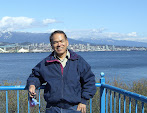
(Bottom photo) Going out of residential neighbourhoods into main road. This one with Vancouver city skylines at the background.

(Top photo) Coming back on the home stretch, I will pass a parking lot of a Community College that now has been turned into a construction zone. The parking lot is slated for expansion to the Community College with a 6 story tall building. The existing College are the 2 buildings shown at the back. I usually stop at the site and do stretching exercises on the pedestrian look-out provided, whilst watching all the activities there. I am always fascinated by construction activities.

Monday, March 26, 2007

Simon Fraser University

Dear Dr Tomas Tarigan,
There are 2 universities in the Greater Vancouver area, University of British Columbia (UBC) and Simon Fraser University (SFU). A few years back I took a very good friend of mine Mintayu br Sembiring visiting from Jakarta (bottom photo), I am sure that you have met her before, to tour SFU main campus in Burnaby, a suburb of Vancouver.

SFU is located on top of Burnaby Mountain, about 45 minutes drive from where I live. It is the highest point in Burnaby, 1100 feet above sea level and has a commanding view of the surrounding areas, including the Fraser River and Vancouver City skyline in the distance. It is the best and most expensive property location reserved for higher learning to keep students inspired and motivated. SFU was designed by Arthur Erickson a UBC architecture professor and his partner Geoffrey Massey with design for growth in mind. The growth was to be incremental and continuous, and to date is still growing and expanding depending on future programs need. SFU was named after a British explorer, Simon Fraser that could be called the founding father of British Columbia, who explored land west of Rocky Mountains and the Fraser River from 1805-1818.
The SFU was opened in September 9, 1965 with 2500 students. Now there are about 25 000 students across 3 campuses: Burnaby as the main campus and the extensions in Vancouver and Surrey. Simon Fraser University offered students in undergraduate and post graduate studies in 6 faculties:

Faculty of Applied Sciences with 5 programs.
Faculty of Arts&Social Sciences: 27 programs.
Faculty of Business Administration: 9.
Faculty of Education: 11 programs.
Faculty of Health Sciences: 2 programs.
Faculty of Science with 11 programs ranging from Biological Sciences to Statistic&Actuarial Sciences.
Counting the specialized and minor programs, there are close to 100 programs in total from the 6 faculties with the 25 000 students enrolled in.

As you might have noticed that Faculty of Medicine, Faculty of Law, Faculty of Dentistry are not offered at SFU. Nor programs in Civil, Electrical and Mechanical Engineering from Faculty of Applied Sciences among other things not offered at SFU. What you can not get at SFU, you probably can get it at University of British Columbia, because the 2 universities are complementing each other. There are close to 4000 students now are doing post graduate studies from various programs in the 6 faculties. A High School graduate with an average of 75% will meet most of the admission requirements to undergraduate programs at SFU.
SFU also has a program in International Development partnership, to assist developing countries in strengthening their knowledge infrastructure, by offering graduate studies to their professionals in the fields of research and development. I have met a few of students in that respect: one Indonesian lecturer from University in Menado doing post graduate studies leading to his MSc in Statistics, another Indonesian lecturer from University in Medan doing his MSc in Resource Management, one student from China doing his MSc and continue to do his PhD in Mathematics and one student from Peru doing his MSc in Physics.
The library is one of the best looking architecture at SFU, and matched with good reference books that are available there. It is an active learning place in itself. Every summer SFU is conducting a lecture series by inviting prominent scholars giving lecture that is open to general public. The prominent Scientist and Conservationist Dr Birute Galdikas an expert in primatologist giving such lecture a few times in the past. She has been over 25 years involved in research and preservation of endangered "orang utan" in Tanjung Puting National Park, Kalimantan, Indonesia.

SFU also has a very good sport programs available to students ranging from basketball, cross-country, football, golf, soccer, softball, swimming, track&field, volley ball and wrestling. A pity that they don't have badminton, my favourite. But they do have regular competition with other universities across Canada in many of the sports above, which organized by CIS (Canadian Inter universities Sport) and NAIA (National Association Intercollegiate Athletics). It is important to have a sound body to have a sound mind by exercising regularly.

(Top photo): Academic Quadrangle, contains major lecture halls, classrooms, offices, corridors and large outdoor gardens. Convocation takes place twice a year one in June and another in October. The parades of Graduates begin at the AQ gardens.
(Bottom photo): Convocation Mall, has a glass roof that covers the entire area. It is used for graduation ceremony, rain snow or shine.

Tuesday, March 20, 2007

Get Set

Dear Tatang Hermawan,
Every year since 2001, I have been participating in the "Vancouver Sun Run", a 10 km run sponsored by newspaper Vancouver Sun and the HSBC bank. The Vancouver Sun Run was started in 1985, and now well into it's 22nd year is the largest 10 km event in Canada, and only second in North America. No doubt with over 50 000 participants in 2006 was the largest ever. The route begins at downtown core at the corner of Georgia and Burrard Streets, continues through Stanley Park, then follows the shoreline of English Bay and finishes outside BC Place Stadium. This year will take place on Sunday April 15, 2007. As usual in the morning the whole blocks of downtown Vancouver and part of Stanley Park where the run is conducted will be closed to traffic except only to emergency vehicles.

I joined the North Vancouver Running Club (NVRC) when I started running in September 2000. There are many running clubs in Vancouver, but I chose NVRC because they are better organized. They practise 3 times a week, but I usually join the Sunday morning practise, because it suits me better. I practise my run during the week on every other day around my neighbourhoods for 45-50 minutes. We are not all runners though, depending on the skill and endurance of individuals, from walkers only, walkers and runners only, and runners only. I usually join the walkers and runners only, it means we walk and run alternately, each week progressing to become full runners by April, a 3 1/2 months training. First week in January starting with run 1 minute and walk 5 minutes, repeating that run/walk ratio 1/5 for 50-60 minutes practise time 3x a week. It keeps progressing to the following weeks from run/walk ratio of 1/5 to next stage of 1/4, 2/3, 3/2, 4/2, 5/2, 7/2, 10/1, 20/1, 22/1, 25/1, 40/1 and 50/1 by April. At ratio of 50/1, run 50 minutes and walk 1 minute, we will be able to beat the magic number of 1 hour time for the 10 km distance. But I could not keep up with the progressions, by the time 25/1 run/walk ratio, my legs and lungs start complaining, so 25/1 kind of my maximum. I often join the runners only group, but only as stragglers always behind with 1 or 2 others. There will be stretching up exercises before and after the run to prevent muscle injuries. The total practise time will be about 1 1/2 hours. My best time for the Vancouver Sun Run was 62 minutes for the 10 km distance, that was when I ran for 54 minutes (actually 2x27 minutes), and fast walked 2x4 minutes. We usually practise our run in different location each time to make it more interesting. So everybody meet at the scheduled time and location. We practise in these locations regularly: Lynn Headwaters Regional Park, Capilano River Regional Park, Ambleside Park, Seymour Demonstration Forest, Bridgman Park, Mosquito Creek Park and Kirkstone Park. Every year after the Run my legs felt sore without fail. The first year I have to take off sick from work for a couple of days, and took me 1 week in total to have my legs back to normal. But now I am used to it, even though after the Run I still feel sore, after 1 day my legs will be back to normal again.

There are many other races other than The Vancouver Sun Run. Some of the members went to Victoria to join the 10 km race there, or to Kelowna, or to Seattle in the States, to Los Angeles, or even to Hawaii. They combine it with their vacation times for sure. I join mostly the one in Vancouver at least one other race a year. I like the "Pacific Spirit Run" in mid May, "Coho Run" in mid September, "Turkey Trot Run" mid October and "CIBC Run for Cancer" in mid October. I follow very closely with great interest the "Vancouver International Marathon" at the beginning of May each year. It is a 42 km marathon that attracted runners from all over the world. No it is not for me.

Wednesday, March 14, 2007

Spring Flowers

Dear Eka Mustikawaty,

This shrub with yellow flowers is called Forsythia. Forsythia is very well known and flowering very early in the spring. Because of winter in Vancouver is not so severe, and it feels spring like weather already, you can see them blooming everywhere. I took this photo today just in my neighbourhood. Spring is more brighter with the presence of yellow flowers of Forsythia that cover the whole tree. The leaves come later just before the flowers fall to the ground. Forsythia can grow as high as 3 m.


This is Flowering Cherry. This tree can grow to 30 m, and typically flowering very early in the spring also. I took this photo a couple of blocks away in front of a Nursing Home. This tree is native to Canada. But the profusely flowering Japanese Cherry tree is more common now in Canadian gardens, because it gives abundance of bright flowers, not too tall and requires smaller space to grow.
I noticed also that there are other plants starting to bloom too: heather is a ground cover with white and purple flowers, camelia is a shrub with yellow and red flowers and some species of rhododendron, Japanese pieris and magnolia with flowers in purple, red and white.

Wednesday, March 7, 2007

Spring time


Dear Tiur br Tarigan,
It is still winter in Vancouver, up to March 21 where spring begins. A few days ago I went for a walk to New Brighton Park, near Port of Vancouver, and took this picture overlooking North Shore Mountains. You can see the snow line half way up the mountains indicating the 0 C freezing level, about 500 m above sea level. There are a lot of snow in the mountains, good for skiing especially in the 3 ski resorts nearby ranging from 30 minutes to 1 hour drive away, where the snows are thicker helped by snow making equipments: Grouse Mountain, Mount Seymour and Cypress Bowl. This time of year all of them packed with cross-country and downhill skiers. I used to do cross-country skiing myself mostly at Cypress Bowl, a 1 hour drive away from where I live. I am only a beginner skier, but learnt fast and in the process of perfecting my "telemark" turn technique. But not anymore since I hurt my back 3 years ago at work. My back is better now, and considering doing it again and I still have my skiing equipment in the storage. Maybe next year if I feel fit I will try cross-country skiing again, it is a lot of fun.

Vancouver winter is usually less severe than the rest of Canada, although it will still be cold, wet and windy. It is seldom snowing, perhaps 2-3 times a year, but more often in higher elevations. Now it feels like spring weather already, day time temperatures hovering around 8-10 C. Spring always come early, usually towards first week of March. This is due to the warm current coming from the Pacific Ocean. The plants are already budding, raring to grow. Spring is the time for dormant plants to come to life again. There are already a lot of them starting to bloom. Funny though when the plants awake from their winter sleep, they show flowers first then leaves. I guess that's how nature works, and the blooms make spring time even more beautiful.

Sunday, February 25, 2007

Nanaimo


Dear Sugeng,
Nanaimo is located in Vancouver Island, about 2 1/2 hours away from Vancouver: 45 minutes drive to Horseshoe Bay ferry terminal and 1 hour 45 minutes ferry ride to Departure Bay, Nanaimo. Vancouver Island itself is about 40 km west of Lower Mainland across the water, and it's size is about 1/4 of Java Island. Victoria is the capital of British Columbia and is the largest city in the Island, and Nanaimo with 80 000 population is the distant second largest city. There are 3 ferries to service Nanaimo - Horseshoe Bay route, the "Queen of Coquitlam", "Queen of Cowichan" and the "Queen of Oak Bay". They are large ferries that each can carry 360 cars and 1500 passengers. It consists of 7 decks, that is the height of a 7 storey tall building. Deck 1 is for engine room, decks 2,3 and 4 are for cars and trucks, decks 5 and 6 are for passengers, and deck 7 for navigational room. The Nanaimo - Horseshoe Bay service runs 8 times daily during winter, but more sailings in summer starting in June to accommodate with the influx of tourists. Tourism is one of the largest industry in British Columbia together with forestry, fishing and mining. The top photo shown is the Horseshoe Bay ferry terminal. The ship that is further away is the "Queen of Oak Bay" on it's way to Departure Bay, Nanaimo. The one that is still on dock is a smaller ferry, a 100 cars and 500 passengers capacity to service the 40 minutes shorter route to Langdale, Sunshine Coast.

Last July 2006, I went for a week to visit a very good friend Tan in Nanaimo, and boarded the "Queen of Oak Bay". Tan and his family immigrated to Canada some 20 odd years ago and opened a restaurant in North Nanaimo. They started the restaurant business in Vancouver a few months after their arrival in Canada. But soon they discovered that there were too many cutthroat competitions around. It was very hard to survive, let alone making a profit, and they were losing money big time. So they looked around for a better alternative and moved to Nanaimo and opened a restaurant there instead. Like most immigrants they work very hard. Essentially it is a family run restaurant business, and everybody has to pitch in, husband, wife, sons, daughters, nieces, nephews and other relatives that happen to come for a visit, have to help and work at the restaurant. I am happy to be treated as one of the family. It is hard work, low profit margins, and therefore the long hours of work to get a decent income. Start at 10 am, and most of the time finish at 2 am next mornings, 7 days a week. They have to, because they need to support their children to go to University, one daughter is attending Dentistry College and one son is in College of Music. They hope that their children will have better jobs than what they now have. They know perfectly well that this is not the best way to make a decent living in Canada, but the only way they know. Having a good education is the best way to go. From time to time they also "have to" send some money to many relatives from both sides in the Old Country, that seems always in need of "emergency" financial helps. Everybody they know in Canada send money back to the Old Country, and they have to send too, and it became a "tradition". The Tan's are very hard workers and very generous too. I admire their spirits. I help them around during lunch time to 3 pm wherever help is needed, sometimes as kitchen help sometimes as a waiter. They did enough help during dinner time. Besides they said they did not want me to work too hard. But I did help them with their paperwork at night time though. They let me stay in their spare bedroom during my one week duration with them.
Here at bottom photo you see me in the kitchen making spring rolls.

I always enjoy the ferry ride during the 1 hour 45 minutes ride to and from Nanaimo. I have been to Vancouver Island a few times in the past. The views of the waterways around Gulf Islands are gorgeous, one of the best in the world. There are probably a dozen populated islands between Lower Mainland and Vancouver Island, and all are always crowded with tourists in summer. I visited one of them 3 years ago, the Saltspring Island for R&R (rest and recreation), and played a couple of rounds of golf. In Nanaimo, in my spare time I visited and explored neighbouring towns: Parksville, Qualicum Beach, Ladysmith and Chemainus. These areas are rich with histories, how the early day pioneers like Robert Dunsmuir who became very rich after discovered coal in 1869 in Nanaimo. Then expanded his empire into logging, shipping and transportation businesses. Nanaimo and Ladysmith were the centre of his operation, and where the first original immigrant settlements developed. People at Chemainus are proud to promote their "town of murals", where the whole communities work together to create large mural paintings that averages 8m x 2m in sizes painted on the outside of building walls across town, and became tourists' attractions. Yes, tourists are really coming to see the hundreds of murals at Chemainus, and help promote the town and the local economy. The murals depicting the history of the areas, about people working in coal, logging, fishing and transportation in the early days. All murals were drawn by local artists and students.

Sunday, February 18, 2007

Crocuses


Dear Elizabeth br Ginting,
These are crocuses, another early plants that start growing in mid winter February. They have a biological alarm clock that wakes them up around this time of year, with flash of beautiful bright color flowers. Their colors vary enormously, but the most common are yellow, mauve, lilac and white. Crocuses are perennial, bulb type flowers called "corms", and belong to the family of irises. They are easy to grow, but require a well drain soil. In winter, squirrels and rodents when their foods are scarce, love to dig the corms from the ground to eat. So the crocuses are planted deeper to deter pests. Crocuses are not natives to the Netherlands, but it was first recorded there in 1560's about crocuses being cultivated. The beauty of crocuses inspired a well known Dutch painter Ambrosius Bosschaert to paint a crocus in 1620, and the original painting is displayed in Louvre Museum. Vancouver avid gardeners generally are having a break between November to January due to the cold winter, and the plants being in dormant state. But in early February gardeners can start enjoying the early blooms of tear drops and crocuses again. And spring time is just around the corner. Before tear drops and crocuses are done, there will be a lot of other flowering plants to start growing and showing their blooms. Everywhere looks alive again. New plants sprouting, replacing the dying olds.